Pinus strobus
Pinus from Latin pinus (pine tree). strobus from a Greek or Latin word of uncertain origin, possibly related to strobos (twisted, whirling), perhaps referring to the cone structure, or from an old name for an incense-bearing tree.
Eastern White Pine
Pinaceae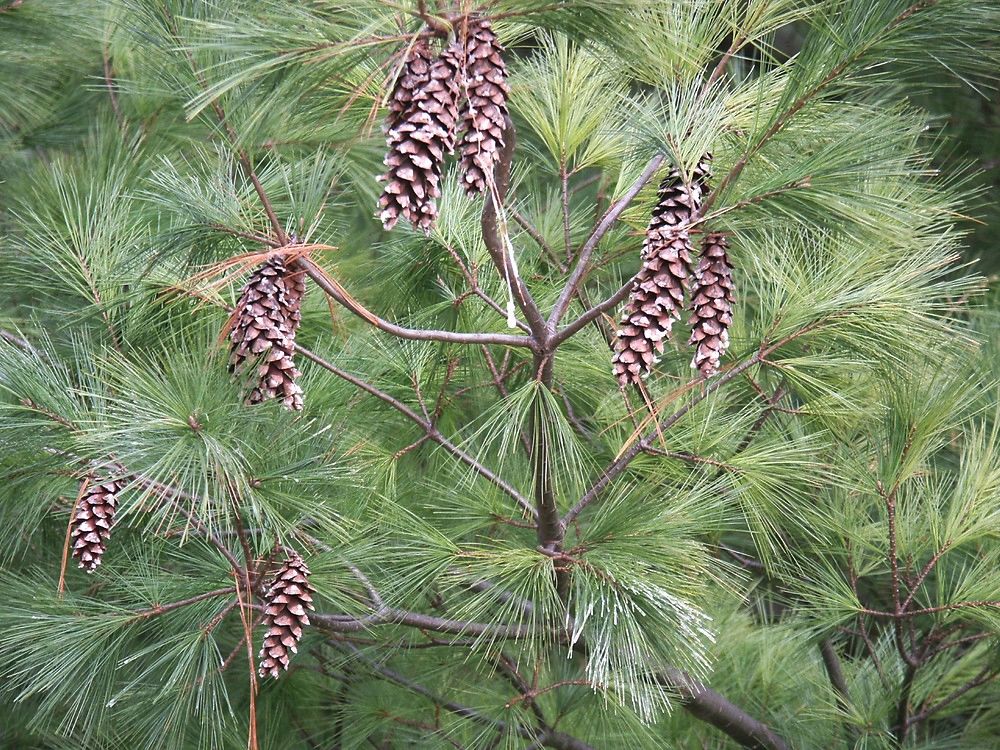
Distinguishing Features
- Needles in fascicles (bundles) of 5 — the only eastern North American pine with 5-needle clusters
- Needles soft, flexible, blue-green, 5–13 cm long, with fine white stomatal lines on inner faces
- Long, slender, cylindrical cones (8–20 cm), often curved, with thin, flexible scales tipped with resin
- Bark smooth and gray-green when young, developing deep furrows and broad, flat-topped ridges with age
- Distinctive horizontal branching pattern, giving mature trees a flat-topped, layered silhouette
- Tallest conifer in eastern North America — mature trees commonly reach 30–50 m
Habitat
Well-drained sandy soils, rocky ridges, old fields, and mixed hardwood-conifer forests. Shade-tolerant when young. Grows in a range of soil conditions but prefers moist, well-drained, slightly acidic soils.
Notes
Historically the most important timber tree in colonial North America — tall, straight trunks were reserved for Royal Navy ship masts under the King's Broad Arrow policy, contributing to colonial resentment. Inner bark is edible in emergency. Needle tea is rich in vitamin C. Highly susceptible to white pine blister rust (Cronartium ribicola) and white pine weevil.