Anubias barteri
Anubias named after Anubis, the ancient Egyptian god of the afterlife and the dead, alluding to the plant's preference for deeply shaded, dark habitats along riverbanks. barteri honoring Charles Barter (1832–1859), British botanical collector who gathered plants in West Africa.
Anubias
Araceae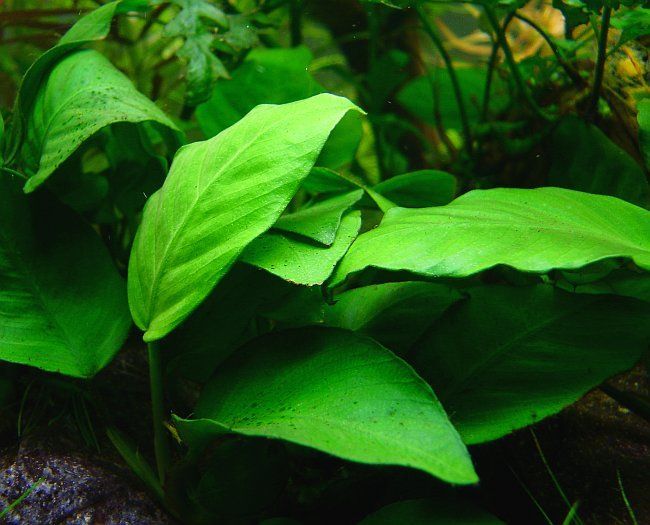
Distinguishing Features
- Thick, leathery, dark green leaves on long petioles arising from a creeping rhizome
- Leaf shape variable by variety — ovate, lanceolate , or spatulate ; prominent midrib and lateral veins
- Rhizome thick, green, creeping horizontally — must not be buried in substrate (attach to wood or rock)
- Extremely slow-growing; new leaf every 2–4 weeks
- White spadix and spathe flower (aroid type) produced even when submersed — one of few aquarium plants that flowers underwater
- Multiple varieties: var. nana (dwarf, 5–10 cm), var. barteri (medium, 20–40 cm), var. coffeefolia (textured leaves)
Habitat
Streams, rivers, and their banks in tropical rainforest. Grows as a rheophyte attached to rocks and wood in shaded, fast-flowing water. Also found emersed on riverbanks subject to seasonal flooding.
Notes
One of the hardiest and most popular aquarium plants worldwide. Tolerates very low light and requires no CO2 or fertilization, though grows faster with both. Must be attached to hardscape (rocks, driftwood) or left floating — burying the rhizome causes rot. Prone to algae growth on its slow-growing leaves (especially in high light). The var. nana is the most popular variety for aquascaping, forming dense carpets on driftwood.