Viola pubescens
Viola from Latin viola (violet, the plant and the color). pubescens from Latin pubescere (to become downy or hairy), referring to the soft hairs covering the stems and leaves.
Downy Yellow Violet
Violaceae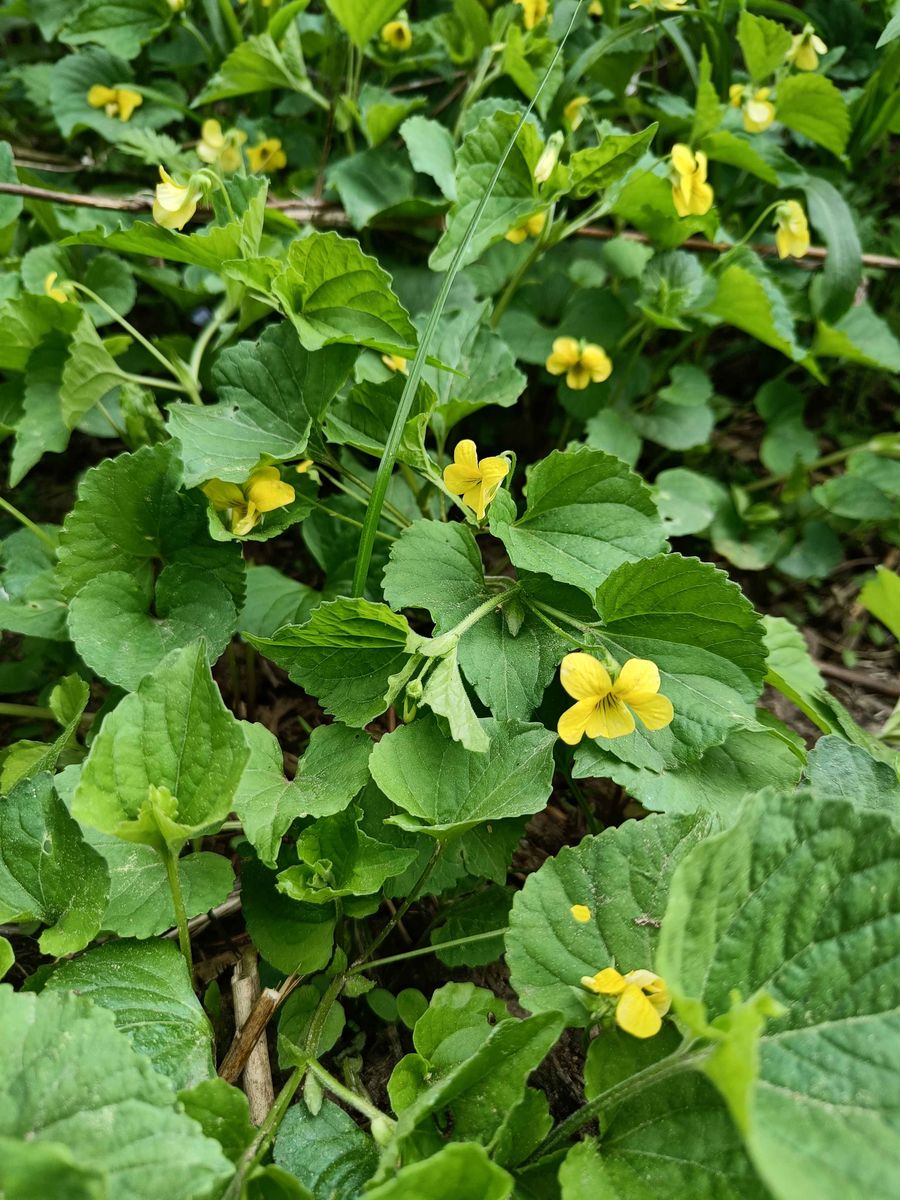
Distinguishing Features
- Yellow flowers with distinctive purple-brown veins (nectar guides) on the lower three petals
- Caulescent — stems bear leaves (unlike acaulescent species where leaves arise only from the base)
- Heart-shaped ( cordate ) leaves with crenate margins, softly hairy ( pubescent ) on both surfaces
- Stems also visibly downy-hairy — key diagnostic vs. the smooth-stemmed V. eriocarpa
- Typical violet flower shape: 5 petals, bilateral symmetry, lower petal with a short nectar spur
- Plant 15–40 cm tall; 1–3 basal leaves plus 2–4 stem leaves
Habitat
Rich mesic deciduous forests, wooded slopes, ravines, and floodplain forests. Prefers moist, humus-rich soils in partial to full shade.
Notes
One of the few yellow-flowered violets in eastern North America. The combination of hairy stems, hairy leaves, and yellow flowers is diagnostic. Like other violets, produces cleistogamous (closed, self-pollinating) flowers later in the season near the base of the plant, ensuring seed production even without pollinators. A spring ephemeral that blooms before full canopy closure.
Tags
Biogeography
Life Form
Phenology
Habitat
Morphology