Rhamnus cathartica
Rhamnus from Greek rhamnos (a thorny shrub, buckthorn). cathartica from Greek kathartikos (purging, cleansing), referring to the strong laxative effect of the berries .
Common Buckthorn
Rhamnaceae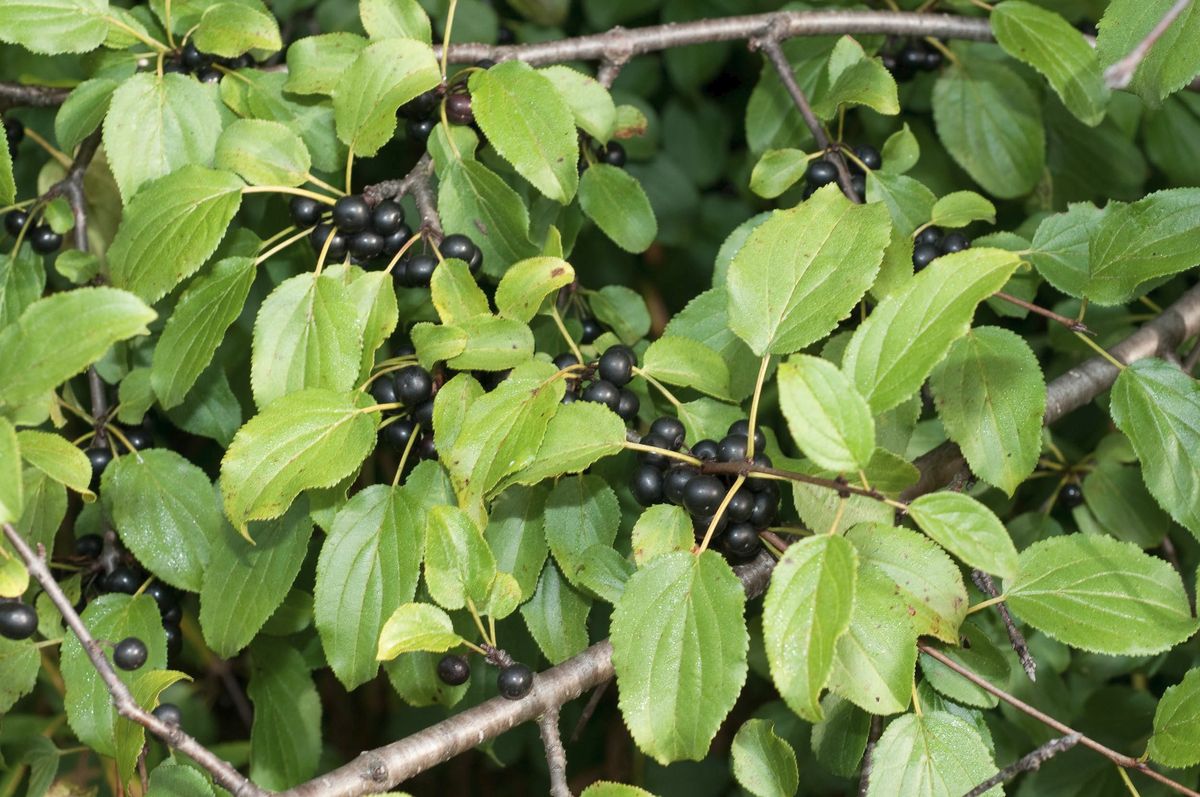
Distinguishing Features
- Branches often terminate in a stout, sharp thorn — the most distinctive field character
- Leaves opposite (sub- opposite on vigorous shoots), elliptic to ovate, with 3–4 pairs of curved veins that arch toward the leaf tip (arcuate venation)
- Leaf margins finely crenate - serrate ; petiole groove present
- Fruit: small (5–8 mm) black berry -like drupes in dense clusters, persisting into winter
- Bark dark grey-brown, with orange inner bark exposed when scratched — key diagnostic
- Leafs out earlier in spring and holds leaves later in fall than most native shrubs
- Dioecious ; small inconspicuous yellow-green flowers
Habitat
Highly adaptable; invades forest edges, open woodlands, hedgerows, roadsides, old fields, alvars, savannas, and disturbed urban areas. Tolerates a wide range of light levels, soil types, and moisture regimes.
Notes
Extremely aggressive invader of natural areas across Ontario and the Great Lakes region. Forms dense monocultures that prevent native plant regeneration. Roots release allelopathic chemicals (emodin) that inhibit native plant growth. Berries cause severe diarrhea in humans (cathartica = purging) but are consumed by birds, aiding spread. Very difficult to control once established.