Morus alba
Morus from Latin morus (mulberry tree), derived from Greek moron. alba from Latin albus (white), referring to the colour of the buds or the light-coloured fruits of some forms — not necessarily the fruit, which can be white, pink, red, or purple.
White Mulberry
Moraceae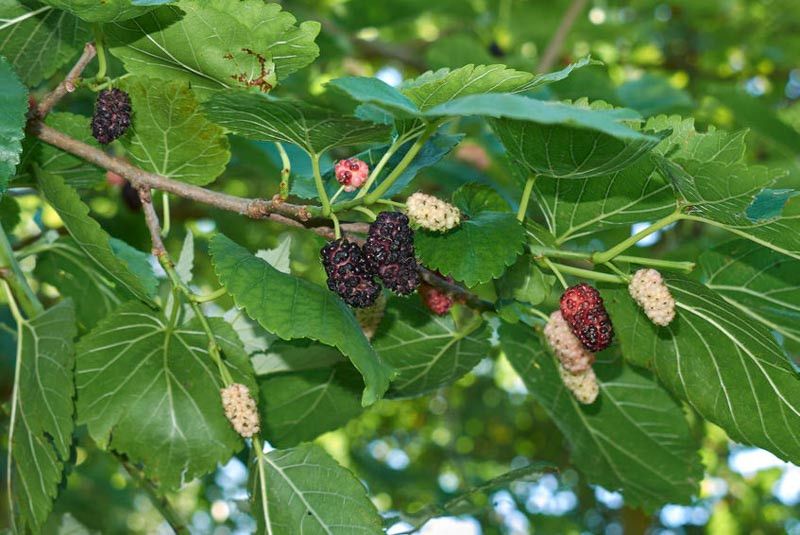
Distinguishing Features
- Highly variable leaf shape — lobed and unlobed leaves often present on the same tree
- Leaves glossy and somewhat thick on the upper surface, with smooth or serrated margins
- Fruits are elongated, cylindrical multiple fruits (syncarp), 1–2.5 cm, ripening white, pink, red, or dark purple
- Milky latex sap exuding from broken twigs and leaf stalks
- Leaves are the primary food of the silkworm (Bombyx mori)
- Buds and leaf scars do not have the orange-brown inner scales of red mulberry (M. rubra)
Habitat
Disturbed areas, urban lots, woodland edges, floodplains, fence rows, and old fields. Highly adaptable, tolerating poor soils, drought, pollution, and salt.
Notes
Introduced to North America in the 1600s for silkworm cultivation, which ultimately failed. Now considered invasive in much of eastern North America. Hybridizes readily with the native red mulberry (M. rubra), threatening its genetic integrity through introgression. Fruit is sweet but often considered bland compared to red mulberry.