Lomariopsis cf. lineata
Lomariopsis from Greek loma (border, fringe) + opsis (appearance), referring to the marginal sori on the fertile fronds. lineata from Latin lineatus (lined, striped). Süßwassertang is German for 'freshwater seaweed,' coined by German aquarist Christel Kasselmann.
Süßwassertang
Lomariopsidaceae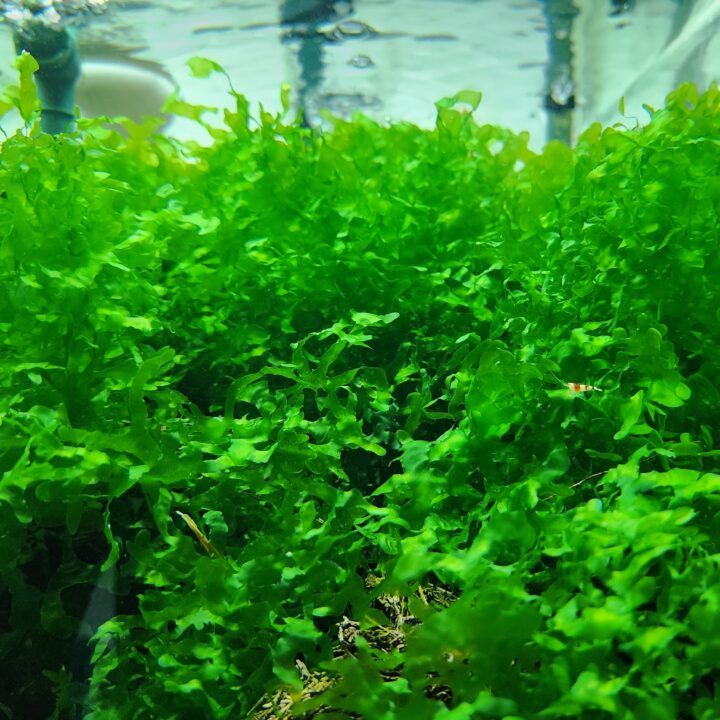
Distinguishing Features
- Flat, irregularly branching, liverwort-like green thallus — resembles a round- lobed seaweed or lettuce
- No true stems, roots, or leaves — this is a persistent fern gametophyte , not a sporophyte
- Bright to dark green, translucent, soft, and delicate texture
- Lobes round-edged, 3–10 mm wide, branching dichotomously
- Grows slowly as an attached or free-floating mass; sinks rather than floats
- Reproduces vegetatively by fragmentation (does not produce spores in the gametophyte stage)
Habitat
Freshwater streams and rivers in tropical forests, attached to rocks and wood in shaded areas. In aquaria, grows attached to hardscape or as loose clumps on the substrate.
Notes
A botanical curiosity — this is the free-living gametophyte generation of a fern, persisting indefinitely without developing into the familiar leafy sporophyte . Identified by molecular analysis as belonging to the fern genus Lomariopsis. Extremely easy and undemanding in aquaria: grows in very low light, needs no CO2, and is eaten by very few animals. Its unique flat thallus texture provides excellent cover for shrimp and fry. Growth is slow. Sometimes confused with Monosolenium tenerum (another flat aquatic plant, but that is a liverwort).