Echinodorus bleheri
Echinodorus from Greek echinos (hedgehog) + doros (leather bag, container), referring to the spiny aggregate fruit head. bleheri honoring Amanda Bleher (1904–2003), German-Brazilian aquarist and plant collector who gathered aquatic plants extensively in the Amazon basin.
Amazon Sword
Alismataceae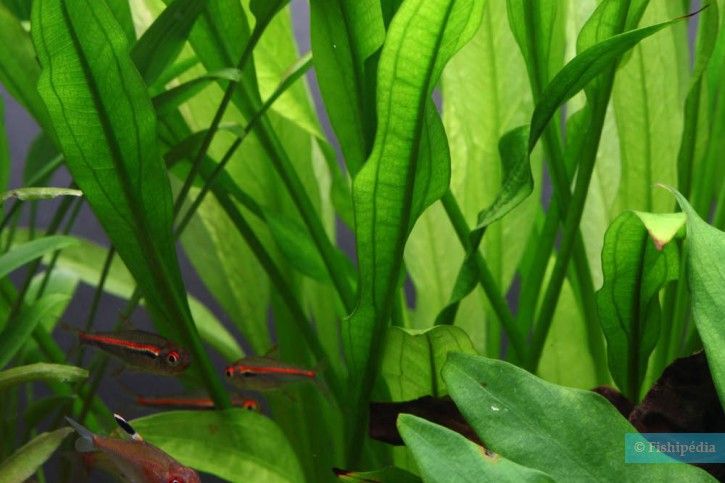
Distinguishing Features
- Large rosette of long, lanceolate , bright green leaves arising from a central crown
- Leaves 20–50 cm long, 3–5 cm wide, with pointed tips and visible parallel venation converging at tip and base
- Robust root system — heavy root feeder that benefits from nutrient-rich substrate
- Produces long emersed flower stalks ( inflorescences ) that arch above the water, bearing whorls of small white 3-petaled flowers
- Adventitious plantlets form at flower stalk nodes (vegetative reproduction)
- Can grow very large (40–60 cm tall and wide) — a dominant centerpiece plant
Habitat
Rivers, streams, and flooded areas in tropical lowland forests. Grows submersed in slow to moderate current, or emersed on muddy riverbanks during dry season.
Notes
The quintessential aquarium centerpiece plant — one of the first tropical aquarium plants ever commercially traded and still among the most popular. Extremely hardy and adaptable; grows in low to high light without CO2. Can outgrow most home aquaria if not managed. Heavy root feeder — benefits greatly from root tabs or enriched substrate. Sometimes reclassified as Echinodorus grisebachii var. bleheri, though E. bleheri is still widely used in horticulture. The flower stalk plantlets can be separated and replanted.